
A Driven Person’s Guide to the Stress Cycle: Why It May Be Causing Your Burnout & What You Can Do About It

For most driven people, stress can become so woven into your everyday life that it really starts to feel almost indistinguishable from who you are.
You’re always thinking about what’s next. You’re solving problems, making plans, anticipating what could go wrong and trying to stay one step ahead. Even when you finally have time to rest, your mind is still quietly working in the background.
And for a while, this can actually work. You get things done. You achieve your goals. You become someone other people can rely on.
Until some day, you realize you are bone-deep exhausted. And no amount of rest will fix it.
Why does this happen to so many ambitious people? Because there’s a difference between being good at handling stress and being good at recovering from it.
That’s why in this article, I’d like to explore a topic that has been gaining a little traction in recent years - called the stress cycle. I’ll break down what a stress cycle actually is, why it is contributing to your constant feeling of burnout and exhaustion and how you can use this info to recharge and feel better.
What is the stress cycle?
Any type of stress is processed by your nervous system in a specific pattern that we call the stress cycle. In order to explain what the stress cycle really is, we first have to understand that there is a difference between a stressor and stress itself.
A stressor is the person/circumstance/thought/feeling, etc. that is causing the disturbance in your life.
Stress on the other hand, is the emotional and physical reaction happening in your body IN RESPONSE TO whatever external or internal stressor you are experiencing.
As an ambitious, driven person, you’re probably pretty good at dealing with different stressors in our life: you switch into problem solving mode, make lists, organize meetings, have that difficult conversation, go to therapy, have backup plans or friends to fall back on when you need them. All in an attempt to eliminate whatever problem was showing up in your life.
What we’re often not so used to dealing with is the emotional and physical effects lingering around in our bodies after the stressor was removed. And that’s exactly where the idea of the stress cycle comes in.
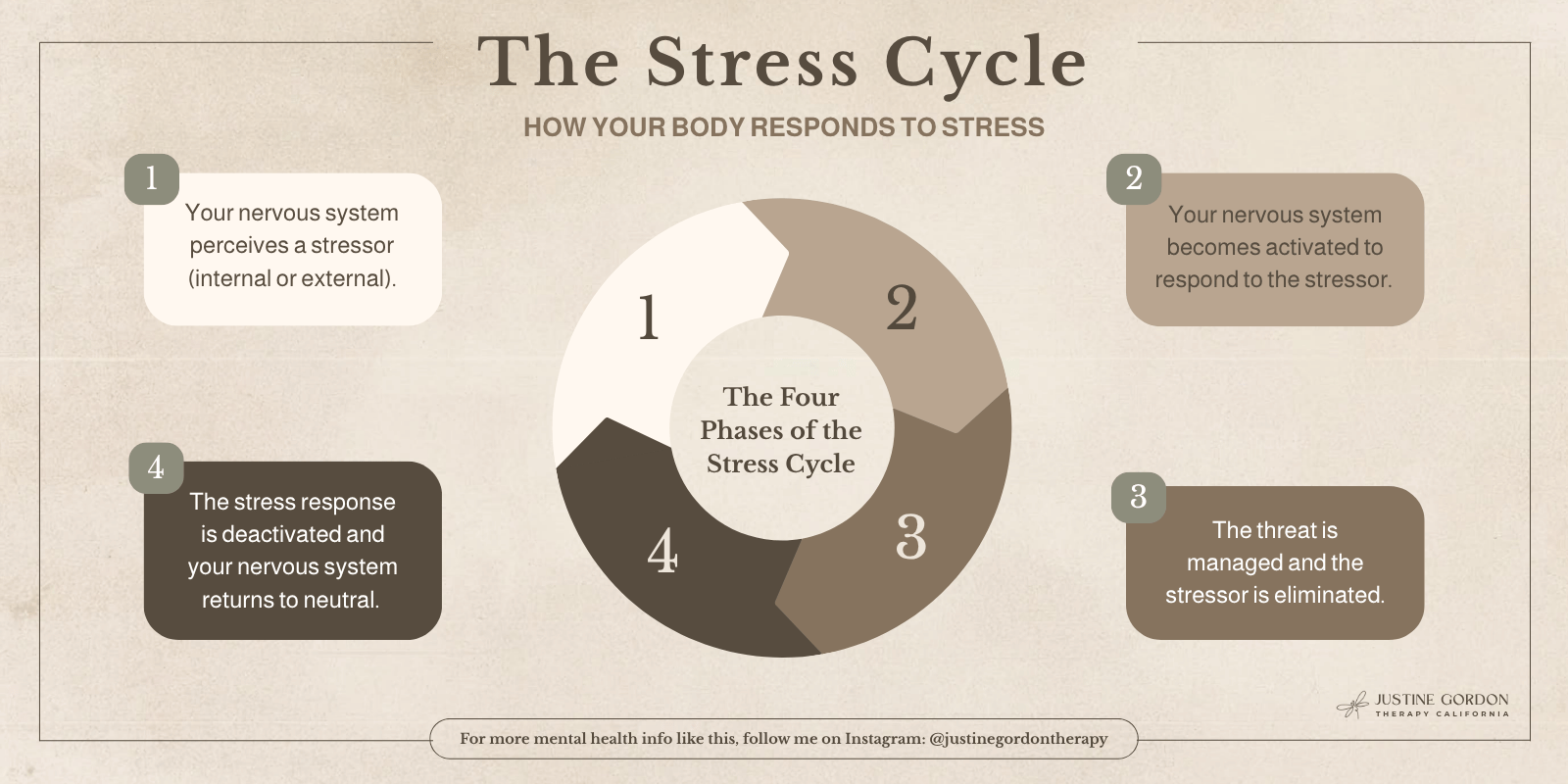
To give you a basic overview, your nervous system responds to stress in four main phases:
1) Your nervous system perceives a stressor
The stressor can be external (your job may be on the line, your in-laws are coming to visit, your car broke down and you don't have the extra cash to fix it) or internal (harsh self-criticism, chronic performance pressure). Regardless of what the stressor is, your nervous system is no longer neutral.
2) Your nervous system becomes activated to respond to the stressor.
Our minds and bodies are basically problem-solving machines. If a stressor is perceived, your nervous system gets activated into fight, flight or freeze mode and produces a bunch of extra mental and physical energy to mobilize you into dealing with the “threat” in whatever way you deem best.
3) The threat is managed and the stressor is eliminated.
As a result of the nervous system activation, the stressor gets managed. Depending on the type of stressor, this can take varying amounts of time but eventually, the threat is dealt with and the stressful situation passes.
4) The stress response is deactivated and your nervous system returns to neutral.
Your body receives certain signals that the stressor has been resolved and you are now safe again. As a response, it can release any extra stress energy it no longer needs and return to its neutral state of calm and safety.
The stressor being over doesn’t automatically mean your body returns to neutral though. If your nervous system doesn’t receive the necessary signals, the body may still hold onto that activation. Especially in situations where it's not always as simple as one stressor ending and another one beginning. So even if the stressor is gone, your nervous system may still be carrying the activation from it.
If you’ve ever had a pet that doesn’t like getting baths, you’ve probably seen this stress cycle in action more times than you can count. You’ll know that what happens after your pet finishes the bath is what we call the “zoomies”: they run around your space like crazy.
Why does this happen? Because their bodies have generated so much energy in response to the perceived threat (aka the bath) that afterwards, they have to release all of it by running around for a few minutes before they are able to settle and return to a normal, calm state.
Similarly, most animals who get into physical confrontations with another animal, will leave that fight and shake/tremble vigorously for a little while so that they can release all of the “fight” energy left in their nervous system.
Why ambitious people never really finish the stress cycle
If you’re reading this article and you think of yourself as someone who is ambitious, driven and constantly striving to work hard, I’m going to take a wild guess and say that some of these are going to sound familiar …
You finish a major project → You immediately start thinking about the next one.
You get the promotion → You immediately worry about proving you deserve it.
You solve the problem → You immediately start anticipating the next problem.
You get through a tough week → You spend the weekend catching up rather than recovering.
You go on vacation → You spend the time thinking about what’s waiting for you when you return.
You make an important decision → You immediately question whether you made the right one.
What’s happening inside your nervous system here is that your brain is never receiving the signals it needs to know it can switch back into safety mode. You’re basically
skipping the fourth phase of the stress response completely and just jumping from one stressor to another, without ever letting your nervous system return to neutral.
So what you’re left with is a stress cycle that looks something like this:
Problem → action → achievement → new problem → action → achievement → new problem …
There are a lot of different reasons for why this pattern is so common among high-achieving individuals.
Part of it is that being a high-achiever usually means you are a good problem solver by nature. So the higher you climb, the more problems you’re presented with along the way, making it easier to justify why you should constantly be staying in motion.
But what I see with many of my clients is that there is also a deeper, more psychological component to not being able to feel safe enough to rest and recover properly.
Driving that need for non-stop motion might be core beliefs like:
“If I’m not achieving, I’m not enough.”
“I need to stay ahead of problems to be safe.”
“People will respect me if I succeed.”
“If I’m not in control, something will go wrong.”
“Resting means I'm falling behind.”
“Slowing down means losing my edge.”
“Other people are depending on me.”
“I don't know who I am when I'm not working toward something.”
Regardless of why you’re not receiving the safety signals after a stressor was dealt with, what this means on a physiological level is that you are not completing the stress cycle in the way that your biology intended.
And when that happens for extended periods of time, you’ll probably start to notice the effects in almost every area of your life.
What happens when you don’t complete the stress cycle
When new clients come to me, they almost always describe an experience that sounds something like this:
“I love what I do and I know I’m good at it but still, I never really feel content. I’m exhausted on a level that I can’t really put into words. I’m always on, always thinking about the next thing. My family is complaining that I’m never present. I can’t fall asleep at night and no amount of sleep makes me feel rested. I always have some weird digestive issue going on. I know I should rest more but silence usually makes me uncomfortable so I just end up busying myself by scrolling, cleaning or doing some other task.”
What I’m describing here is more than just feeling a little stressed or having a particularly busy few weeks. When your body and mind stay in chronic nervous system activation for too long, you’ll start noticing changes emotionally, mentally and physically that usually overlap with what we call “burnout symptoms” quite well.
Emotional symptoms
Constantly feeling on edge, overwhelmed and irritated
Never feeling genuinely relaxed or at ease
Guilt or anxiety when you do try to rest
Feeling emotionally numb, disconnected or less able to experience joy
A persistent sense that you should be doing more
Becoming unusually reactive to small problems or inconveniences
Mental symptoms
Racing thoughts or a mind that rarely feels quiet
Constantly thinking about what needs to happen next
Overthinking decisions, conversations or mistakes
Difficulty being present because mentally, you’re always somewhere else
Trouble switching off from work or responsibilities
Not being able to stop problem-solving, even when there aren’t any
Difficulty concentrating or making decisions
Physical symptoms
Persistent fatigue or feeling “wired but tired”
Difficulty falling asleep or staying asleep
Waking up feeling unrefreshed, even after getting enough sleep
Muscle tension, jaw clenching or headaches
Digestive problems or changes in appetite
Restlessness or difficulty feeling physically settled
Most high-achieving individuals don’t usually take these symptoms seriously right away because they might not be impacting your performance or your results in a way that is super apparent to you.
I’ve noticed that many of my clients were able to keep functioning at an incredibly high level for a long time, while quietly depleting themselves and their body of more and more energy in the background.
Evidence-based strategies to help you complete the stress cycle
So what can you do to actually change this pattern and give your body the chance to complete the stress cycle fully?
Before we get into what does help, I want to talk about something that can be surprisingly confusing: not everything that feels relaxing is actually restorative.
Why “resting” isn't always the same as recovering
If you're exhausted, you probably already know that you need to rest. You might spend an evening on the couch, scroll through your phone. And sometimes, those things genuinely feel good. There's nothing wrong with wanting to zone out after a difficult day.
But there's a difference between getting a break from your responsibilities and actually helping your nervous system come back down into a neutral state.
Some of the most common ways we’re used to coping with stress include:
Scrolling on social media: Endless scrolling definitely gives your brain something else to focus on, but it always keeps you engaged with a constant stream of stimulation.
Binge-watching TV: Don’t get me wrong, this can be enjoyable and distracting, but passive distraction doesn't necessarily help your body discharge the physical activation that comes with stress and it doesn’t send your brain that “I’m safe now” signal.
Numbing with substances: Alcohol or cannabis may temporarily change how you feel, but they don't actually resolve the underlying stress response either.
Sleeping more: Obviously, we all know that sleep is incredibly important for recovery! But just spending more time in bed doesn't automatically change your chronic nervous system activation, especially when the stress is already interfering with your sleep quality.
Trying to accomplish more: I get it! Cleaning, organizing, answering one last email, running a few errands or finding another task to accomplish can feel productive and even calming in the moment. But again, it can also keep you in the same “there's always something else to do” state that contributed to the stress in the first place.
I want to make it clear that none of these things are inherently bad. You don't need to give up Netflix or your evening Instagram scroll.
The important question is really whether what you're doing is helping you genuinely come back into a state of safety and connection or simply helping you avoid feeling how stressed you actually are.
So what actually helps complete the stress cycle?
The good news is that you don’t need to start doing crazy things to overhaul your entire life. Your nervous system actually responds to some surprisingly simple things that can communicate to your brain and body that the threat has passed and that it's safe to begin coming back down.
Some of those strategies that can help include:
Physical activity
Think pet zoomies! Walking, running, shaking, dancing, stretching or any other kind of movement that allows your body to burn through some of that excess physical activation. For someone who spends most of their day in their head, getting back into your body can be particularly helpful.
Slow, intentional breathing
Breathing is the key to controlling your nervous system. Particularly breathing that emphasizes a longer, slower exhale, which can help encourage a more relaxed physiological state.
Positive social connection:
Spending time with someone who makes you feel safe, supported and genuinely at ease. Human connection can be a powerful signal that you don't have to handle everything alone.
Laughter or crying
Genuine emotional expression can help you move through an experience rather than continually holding it in. You don't need to be forcing this, the point is simply to give your emotions a space where they can be expressed safely.
Creative expression
Another great way to express extra energy in a unique way. Writing, painting, playing music, cooking, gardening or doing anything that allows you to engage without needing to perform or produce an outcome.
And there's one thing I want to note here because I know how your high-achieving, driven mind can work in these instances:
None of these activities are about accomplishing anything great.
It doesn’t matter if you’re good at them or not. You don't need to track anything. You don't need to optimize or become the best at any of them.
If you’ve spent most of your life measuring your worth through achievement, that mindset shift alone can be a huge part of what makes these activities so restorative in the first place.
Final Thoughts: When The Stress Never Stops
The more I work with driven, high-achieving people, the more I’ve come to believe that chronic stress and burnout aren’t necessarily always a problem caused by doing too much. Sometimes, they’re caused by never quite allowing yourself to be done.
You can finish the project, solve the problem, get through that difficult conversation and accomplish everything you need to accomplish but still feel this inner pressure that you need to keep going. There's always another goal, another responsibility, another thing you could do better.
And over time, things simply become too much to handle.
For me, understanding the stress cycle is so helpful because it offers a different way of looking at chronic stress and burnout. Instead of asking yourself “How can I become better at handling everything?”, you can start asking “How can I help myself recognize when I’ve done enough and it’s safe to let go?”
That shift can be surprisingly powerful.
You don’t need to stop being ambitious. You don’t need to become someone who cares less, works less or wants less from life. You simply need to make room for the other half of the equation: the ability to come back to yourself after you’ve been pushing.

Are you looking for a therapist for ambitious, driven individuals in Los Angeles, California?
Justine Gordon is a Los Angeles–based Licensed Marriage and Family Therapist who works with ambitious, driven adults experiencing anxiety, burnout, perfectionism and chronic stress. Having grown up in a high-achieving environment herself, she understands the complicated relationship that can develop between success, self-worth and well-being.
If you’re feeling constantly “on” and struggling to slow down, therapy can be a space to understand what’s keeping you stuck in that pattern and learn a more sustainable way of moving through life. Schedule a free consultation with Justine to see if working together feels like the right fit.